
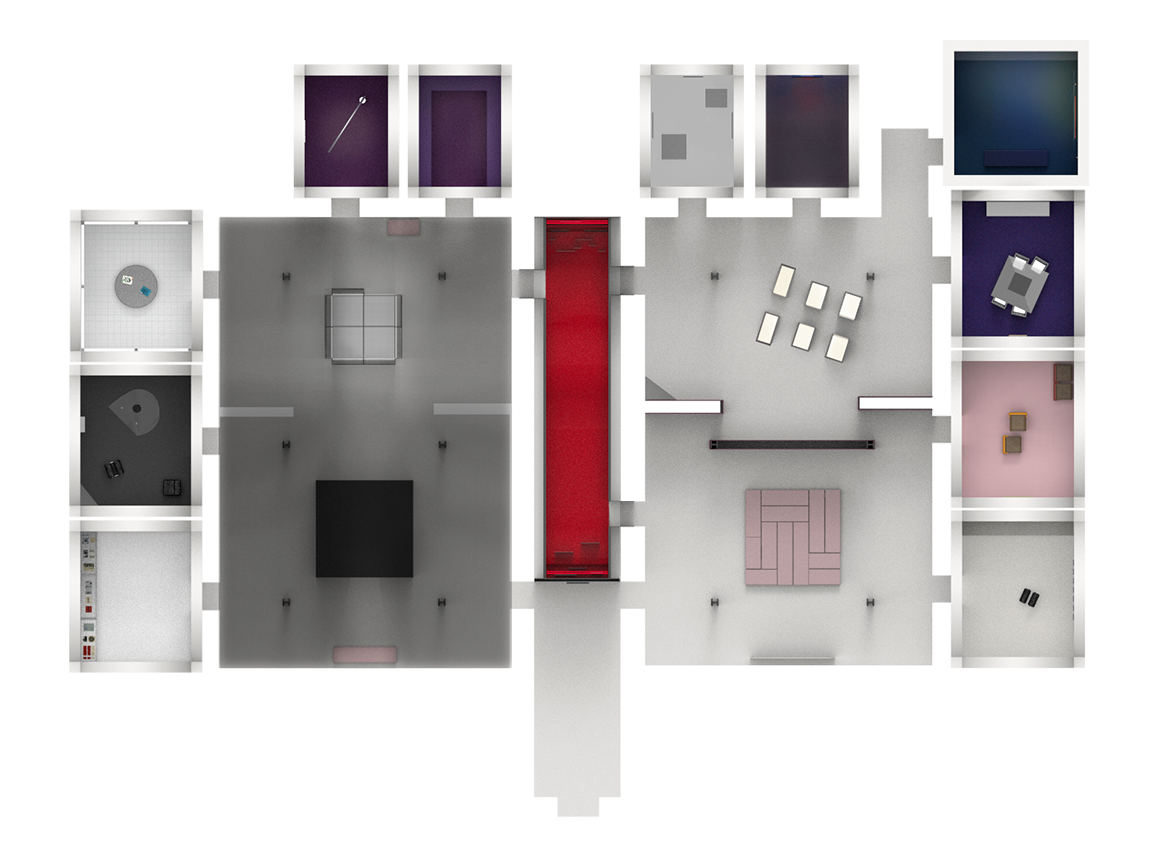


5. Arredoluce
See the localization on the map
Nanda Vigo, floor lamp Linea model 14031, 1970 - Edition Arredoluce - Chromed steel, fluorescent tube - Courtesy of Archivio Nanda Vigo, Milan
Nanda Vigo, table lamp Utopia model 14106, 1971 - Edition Arredoluce - Steel, neon - Courtesy of Didier et Clémence Krzentowski / Galerie Kreo
Nanda Vigo, table lamp Iceberg model 14088, 1969 - Edition Arredoluce - Steel, glass, halogen - Courtesy of Archivio Arredoluce / Fragile Milano
Nanda Vigo, floor lamp Manhattan model 14105, 1971-72 - Edition Arredoluce - Brushed steel, neon - Courtesy of Luca Preti collection
Nanda Vigo, prototype of floor lamp model 14033, 1968 - Edition Arredoluce - Steel - Courtesy of Archivio Arredoluce / Fragile Milano
Nanda Vigo, wall lights Geometral model 14073, 1970 - Edition Arredoluce - Chromed steel - Courtesy of Justine Despretz
© Valérie Sadoun
The collaboration between Nanda Vigo and Arredoluce lasted only four years, but was very productive. Angelo Lelii, managing director and founder of the company, agreed to produce Vigo’s designs, which were technically bold and difficult to position on the market, like Golden Gate. Arredoluce was a manufacturer of mass-produced objects that retained a craft dimension in their research, materials, systems of production, lines and functions. These light fittings show the changing tastes of Italian society in the 1970s.
For a company like Arredoluce, which continually shifted between tradition and innovation, the classic and the modern, Vigo’s arrival represented a turning-point, a third stage in its history, following on from the fundamental experiments carried out with Ettore Sottsass and Gio Ponti in the preceding decades. Fourteen models were designed by Vigo and produced by Lelii, in addition to a large number of pieces that did not get beyond the prototype stage. Production numbers remained low: a few dozen units for nearly all models, with the exception of Linea and Manhattan, which were produced in larger quantities for export mainly to the United States.
The Manhattan floor lamp (1971) is exemplary in terms of technical research. It comprises two plates of brushed metal placed vertically and held together by magnets that conceal the neon tubes inside. This design gives the surface a smooth appearance, with no visible screws or joints.
To show what a rich collaboration it was, a selection of stainless-steel light fittings produced by Arredoluce between 1968 and 1971 are presented here: table lamp Iceberg (1969), wall and table lamps Geometral (1970), floor lamp Linea (1968), table lamp Utopia (1971), floor lamp Manhattan (1971) and floor lamp protype of model 14033 (1968).

Nanda Vigo, floor lamp Linea model 14031, 1970 - Edition Arredoluce - Chromed steel, fluorescent tube - Courtesy of Archivio Nanda Vigo, Milan
Nanda Vigo, floor lamp Manhattan model 14105, 1971-72 - Edition Arredoluce - Brushed steel, neon - Courtesy of Luca Preti collection
Nanda Vigo, prototype of floor lamp model 14033, 1968 - Edition Arredoluce - Steel - Courtesy of Archivio Arredoluce / Fragile Milano
Nanda Vigo, table lamp Utopia model 14106, 1971 - Edition Arredoluce - Steel, neon - Courtesy of Didier et Clémence Krzentowski / Galerie Kreo
© Valérie Sadoun

Nanda Vigo, table lamp Iceberg model 14088, 1969 - Edition Arredoluce - Steel, glass, halogen - Courtesy of Archivio Arredoluce / Fragile Milano
Nanda Vigo, table lamp Geometral model 14072, 1970 - Edition Arredoluce - Chromed steel - Courtesy of Justine Despretz
Nanda Vigo, wall lights Geometral model 14073, 1970 - Edition Arredoluce - Chromed steel - Courtesy of Justine Despretz
© Valérie Sadoun

© Valérie Sadoun

© Valérie Sadoun